
77 Questions customers ask when evaluating Octave Attune EAM
VisualK has been marketing, selling, implementing and supporting Octave Attune EAM since 2007. In all those years I think we have heard every question prospects and customers ask when they are evaluating Octave Attune EAM (obviously exaggerating here). So, we sat down and wrote as many questions as we could remember and decided that we could post it our blog for those of you out there thinking if Octave Attune EAM is the right solution for your business.
However, you just don’t buy a piece of software, you buy a complete solution which includes software and consulting services to make it work for you. The following 77 questions include information about HxGN, VisualK, Contracts and Implementation.
Who is HxGN?
Hexagon is a global leader in digital reality solutions. Combining sensor, software and autonomous technologies. They are putting data to work to boost efficiency, productivity, quality and safety across industrial and mobility applications. Technologies are shaping production and people related ecosystems to become increasingly connected and autonomous – ensuring a scalable, sustainable future.
Hexagon is located in Estocolmo, Suecia and then offices across the planet.
Who is VisualK?
Since 1997, VisualK has been committed to add value to its customers through the implementation of processes, software and technology to solve their needs. A gold channel partner with Octave Attune EAM Global Solutions, VisualK is focused in its Enterprise Asset Management (EAM) practice. Our portfolio of asset management and maintenance customers includes electric power generators, fleet operators, manufacturers and facilities managers. VisualK has offices in Atlanta, Georgia, San Juan, Puerto Rico, Guatemala and El Salvador. We are not allowed to say that we are the best partner in the galaxy.
What is a channel partner?
As a channel partner, we market, sell, implement and support some of HxGN’s product mostly in regions where HxGN does not have offices. Another important aspect is that when you decide to buy the software, you do not buy it from VisualK. You buy it from HxGN. VisualK acts as an intermediary and we receive a commission from HxGN on software sales.
How old is Octave Attune EAM?
How frequently does HxGN update Octave Attune EAM? The current encarnation of Octave Attune EAM has been around since 2000. But it has evolved from MP2 which has been (and still is) around since 1986. There is a major release annually.
Is there a roadmap?
Can we get a copy of the roadmap? There is a roadmap which is presented to customer. However, this roadmap is subject to change and it is for information only. This document is delivered to customers.
How should I evaluate Octave Attune EAM?
RFP? Requirements Matrix? A requirements matrix of some sort is probably the best starting point to conduct a thorough and serious evaluation. Depending of the scope, complexity and budget you may be required to conduct a formal Request for Proposal (RFP) process. One key consideration is the composition of the evaluation committee. It should be headed by Operations and Maintenance with the support of Information Technology (not the other way around, but that’s just me)
Can I just download a requirements matrix?
Thanks to the magic of the Internet and Google you can find almost everything, including a CMMS or Asset Management System requirements matrix. But please, don’t just copy and paste it. It should be a good start and the beginning of the conversation.
Can VisualK help in the evaluation process?
Our job is to help you understand your requirements and the best options available to fulfill them.
What are the functional areas that will benefit (or by impacted) by implementing EAM?
Maintenance, Engineering, Accounting, IT, Reliability, Inventory Management, Procurement and Operations
Do we need to involve our IT department/leadership in the selection and implementation process?
You should. If the software will be implemented on-premise, they must understand and determine what servers will be used, what database will be used and all the fun stuff that goes with it. If Octave Attune EAM will be implemented in the cloud (Software as a Service, or SaaS), they should still be involved.
What kind of contracts will be required for this kind of project?
Implementing Octave Attune EAM has two sides; licensing and services. You will execute the following contracts with HxGN; Software License Agreement (SLA) and Software Support Agreement (SSA), Order Form (OF) or a Subscription License and Services Agreement for Cloud deployments. You will execute the following contracts with VisualK; Consulting Services Agreement and Statement of Work.
What pre-work do we need to do before the implementation?
Clearly define your requirements and objectives for the project. Make sure all the parties involved or impacted are informed and committed.
What are the most common risks to be considered when implementing?
Most risks come from the unkowns. Sometimes we don’t know how good the data and how much effort will go into sorting, cleaning and loading data into the system. Other times we don’t know how good/bad the communications (network, internet access) are. Sometimes an integration partner is not fully engaged in the project. But our #1 enemy is not having management involvement and support.
How much would the implementation cost?
There is no set price. It depends on the modules, the number of users and the implementation scope. All of these are estimated initially and later validated after the design document has been approved.
How long does it take to implement EAM?
Depends. We have implemented combined-cycle power plants using our implementation accelerator in just 3 months.
What is the typical duration of the project?
A typical implementation of Octave Attune EAM usually takes 6 months, without an implementation accelerator.
How do you estimate how much does a project costs?
It based on the scope defined for the implementation. There are 2 main costs: licensing and, services. Licensing is determined by the number and types of users as well by any advanced module required. We estimate the services by defining an implementation plan which includes tasks (based on the scope), resources and time using Microsoft Project. The project consulting fees are calculated using the Microsoft Project cost estimation functionality.
What is time and material?
We report and tally the time spent per activity. The actual time by a resource times the resource hourly rate yields the actual consulting fees that are charged to a project/customer.
What is fixed-price?
Under a fixed-price agreement, the parties negotiate a lump sum for the execution of the project.
Which one is more convenient?
Which one is more fair? In our experience, a Time and Material engagement is more convenient because users are constantly aware of the importance of using everyone’s time in the best way possible. No never-ending meetings, no running around. It has been our best tool to keep everybody aligned. If we (that’s VisualK AND the customer) have done a good job defining requirements and scope and estimating there should be no surprises and the cost should be kept under control. Fairness is a function of risk.
What is the difference between On Premise (On-prem) and Software as a Service?
First and foremost, It is important to understand that it’s the same software with the same features either way. On-premise refers to installing the software in your server(s) and users connect to it through your network (do people still use the term intranet?). Contractually, you buy the perpetual license and then you pay a annual maintenance & support fee. Software as a Service is like a rent, which is paid annually.
What is perpetual licensing?
You own the software and you can use forever.
What is Annual Maintenance & Support?
This is a fee that entitles the customer with new releases and patches of the software (hence maintenance). It also entitles the customer to access the InforXtreme or Concierge system to create support tickets and receive assistance with said tickets when Octave Attune EAM misbehaves (hence support). However, VisualK provides 1st level support and then raises issues/bugs to HxGN for 2nd level support.
Why must we pay M&S before we begin to use the system in production?
Can’t we just start paying maintenance & support when go-live? You may be able to use Octave Attune EAM in production in a few days or weeks and you may require support during the implementation process.
Who will support our company once the implementation project has been completed?
This is where the Maintenance & Support program comes in so VisualK and HxGN will support you. VisualK offers the Advanced Assistance program which is based on a pre-defined block of hours for the year to conduct training, implement additional functionality and support.
What is a named user?
This is a type of licensing in which every user that is granted access to Octave Attune EAM is required a licensed.
What is a concurrent user?
Under this licensing, you can grant access to an unlimited number of users (names) but the number that can be connected to the system at any time is determined by the number of concurrent users licensed. It’s really a pool of users.
Which one should I use?
Named. HxGN does not license concurrent users anymore.
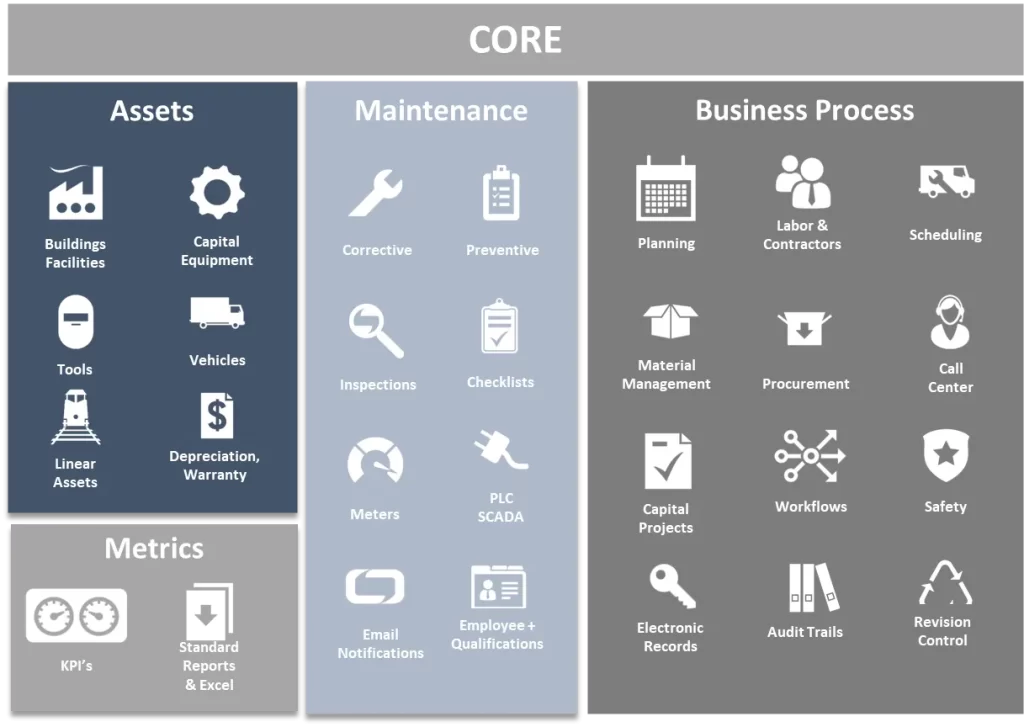
What modules do you offer?
A lot! The following diagram illustrates the available modules in Octave Attune EAM
What modules should I use (implement)?
It depends on your industry and circumstance. You must have assets, work management, metrics and reports. You should consider Inventory Management to control your spare parts inventory. You also have the option to procure parts and services from Octave Attune EAM. Few maintenance people sit at their desks all day, so you want to consider using the application on your mobile device (tablet or smartphone).
How would we know what to implement?
Let us guide you. We have the experience implementing Octave Attune EAM in your industry. We will suggest the functionality and processes that should be implemented and provide you with insights and best practices so you can make an informed decision.
Do I have to implement everything at once?
You do not. At a bare minimum set your assets and corrective work orders and then build from there. However, it would most helpful if you take the time to define objectives and goals and what functionality you would/should implement in the initial phase of your project and then phase it. This will pave the way for determine how each module should be configured to facilitate adding modules later.
Should we implement everything at once or should we do it by phases?
We passionately believe in crawl, walk, run. However, defining a long-term vision for an asset management program will provide direction and help determine the implementation sequence.
What if we don’t have a system today?
You probably have something, maybe Microsoft excel. But if this is the case, the main challenge is collecting your asset data. We have some pre-defined data templates built for the electrical/power generation industry for gas/diesel turbines, steam turbines, low-speed diesel engines, hydro-electrical plants and wind farms.
What if we have a system now?
This system becomes our primary source of master data for assets, preventive maintenance schedules, parts, suppliers, etc.
What is the project scope?
How is it documented? Together we define and align the project scope. It is part of the initial proposal and is the base for then estimate. Once the project officially begins, we dig deep into the scope during the design sessions and document everything going into Octave Attune EAM in the Design Document.
Can I change the scope once we have begun the implementation process? How do we change the scope?
These things happen. We just need to control them. This is documented and approved in a Change Order
Does it make sense to change the scope?
The only constant in life is change. But when it comes to implementing Octave Attune EAM, VisualK is extremely strict and we put a lot of time and effort in the initial phase of the project designing and documenting the scope. A justified change may be required. Someone saying at the end of the project “I thought the system would do this….” is a failure.
What is a change order?
It is a document which describes the nature and justification for the change, its impact on the implementation in terms of additional/less time and/or cost.
Who authorizes a change order?
It requires the signature of both the customer and VisualK’s project managers.
Do I need consulting services to implement?
Not necessarily. Can we do it by ourselves? Not necessarily. You need training and you would benefit from having a guide to navigate the implementation process.
Can we implement after just going through training?
You can. However, there is no training in world that would give you the knowledge that comes with years of experience. You should consider consulting services as part of your budget.
What is the process for implementing?
We have a methodology to guide this process, but in a nutshell, it works like this. We start by defining and design exactly how the system will work for you including work processes, metrics and reports. Then you configure the system in a test environment where you train and test to ensure that the system complies with the design. When you determine that the system and the users are ready, you setup a new environment and begin using the system in your day-to-day operations.
Where is the implementation work done?
Remotely versus onsite? How do I know the labor time reported is right? How do I know that we are being charged correctly? Before COVID-19 80% of the work was done remotely in one of our offices in San Juan, Guatemala, El Salvador or Atlanta. We used to visit customers to conduct design sessions, training and provide onsite support during a go-live.
As of March of 2020, during the COVID-19 pandemic, we have begun new projects and have been conducting all activities remotely may be done in a house in San Juan, Guatemala, El Salvador, Miami or Atlanta. Our consultants report their daily hours for a project and these are validated by the VisualK Project Manager. We submit detailed time sheets as supporting documentation for our invoices. However, the most important factor is TRUST. We understand that trust is hard to earn. And extremely easy to lose.
What is an engagement manager?
The engagement manager is senior member of our team that manages the relation with the customer and drives the discussions with senior management to understand the vision, strategy and objectives of implementing Octave Attune EAM. He is the ultimate responsible for the success of the project. Why should we use the engagement manager? There are soft and hard skills in an implementation project and the team. The engagement manager brings the experience and soft skills to the high-level conversations and translates that for the rest of the team.
Who needs to work in the implementation from our side?
Who are the key-users? What is the role of a key-user before, during and after an implementation? The key-users (also known as Core members) are experts or are familiar with the business area that the system covers along with the terminology and practices. They support the definition of Project scope including the examination of your business and define what Octave Attune EAM should do.
Work with your staff, management, and technical support staff and obtains information by conducting interviews, working sessions, and site visits. Provide in-depth knowledge of the business and assumes responsibility for design decisions, execution of system setup, and validation that design meets the business needs of the organization.
How much time/effort should they spend?
These are the people/roles that participate in a typical project and a ballpark estimate of the time that they need to invest:
- Project Sponsor. 4hrs per month
- Project Manager. 16 hrs/month
- Key-User (Core Team Member). 10 hrs/week
Do we need a project manager from our company?
Yes. Your team would need to work hand in hand with our consultants and the company project manager will coordinate the internal activities and ensure that people deliver, and plans are met. What is the role of the consulting services project manager? To coordinate our consultants, ensure that the project is delivered on-time, withing budget and to your satisfaction.
Who makes the best project manager?
An IT or functional person? In our experience, a functional person can do a better job. However, either an IT or functional person with project management experience and/or certification should be considered.
What is the role of IT during the Implementation?
IT plays a support role. It is most important to understand that implementing Octave Attune EAM is NOT an IT project. It is an Operations and Maintenance project which could be supported by IT. There are some organizations, where IT are the experts at implementing systems and they can lead. To our friends in Operations and Maintenance, don’t walk away from the project because IT may be leading it.
Do I need to have a programmer in-house?
What would be the typical things that require a programmer? You don’t. If some integration is required, having a programmer around could help.
Can I make my own reports?
What tools are available to produce our own reports? Yes you can. Octave Attune EAM has a module called Advanced Reports which is based on IBM’s Cognos, that allows a user, with SQL experience, to edit standard reports or create new reports. If on-premise you can use other reporting tools, such as Crystal Reports, to generate reports outside of Octave Attune EAM.
Do I need to have a PMO?
Do we need to have a certified Project Manager? You don’t absolutely have to, BUT IT REALLY HELPS. More organizations realize the value of having these professionals in their roster.
Is there a methodology for implementing?
Yes. Are there different methodologies? We use 2; Infor Deployment Method (sort of traditional waterfall process) and the newest which is called Agility. Agility is based on the principle that Octave Attune EAM is pre-configured for your industry and, by design, meets 60% of your requirements. 30% requires some additional configuration and would include things like integrations to other systems and 10% is unique to your business/industry.
Which one should I use? The first criteria is whether there is a pre-configured solution for your industry. The second is if your business/industry conforms to the 60/30/10 guide.
What if we have our own methodology?
We will evaluate it and if it makes sense, we can work with it.
What is a design session?
This is a workshop conducted by our consultants with your key-users to discuss the processes and requirements for the implementation.
What is a design document?
This is the blueprint for the project. We put the specific details of which modules will be implemented and how exactly these modules will be configured. It also describes the workflows, controls and metrics that will be implemented. Who is responsible for creating a design document? VisualK is the ultimate responsible for drafting the document. We review it as a team. You decide what stays and what is taken way.
What is key-user training?
Once the test environment has been configured, our consultants train the team members responsible for testing the system.
What is a User Acceptance Test (UAT)?
These tests are performed by the key-users and the objective is to validate that the system has been built as per the design.
What is a development environment?
This is a copy of the Octave Attune EAM where we configure, develop, test and then test some more. It also serves the purpose of training environment. Think of it as a staging area.
What is a production environment?
This is where, once deployed, users go on a day-to-day to transact. It only contains the final, approved version of the configuration, metrics and reports.
Why everything is done in a development environment and then done again in a production environment?
The production environment must be a “clean” environment with only real transactions. Development, testing and fine-tuning will introduce a lot of transactions that you don’t want in your reports, right?
What documentation is produced during the implementation?
Here’s the laundry list:
- Statement of Work (SOW) and other contracts
- Design Document
- Project Implementation Plan (MS Project)
- Change Orders
- Charter and Scope
- Weekly Project Status Report
- Risk Register
- Cutover plan
- Closing report.
Which meetings do you have during the implementation?
We are not big fans of meetings (for the sake of meetings). Over the life of the project we typically meet for these activities:
- Design sessions
- Design review sessions
- Weekly status review (customer and VisualK project managers)
- Key-user training
- User acceptance test sessions
- Readiness assessment
- Post-implementation audit and review
- Closing report review
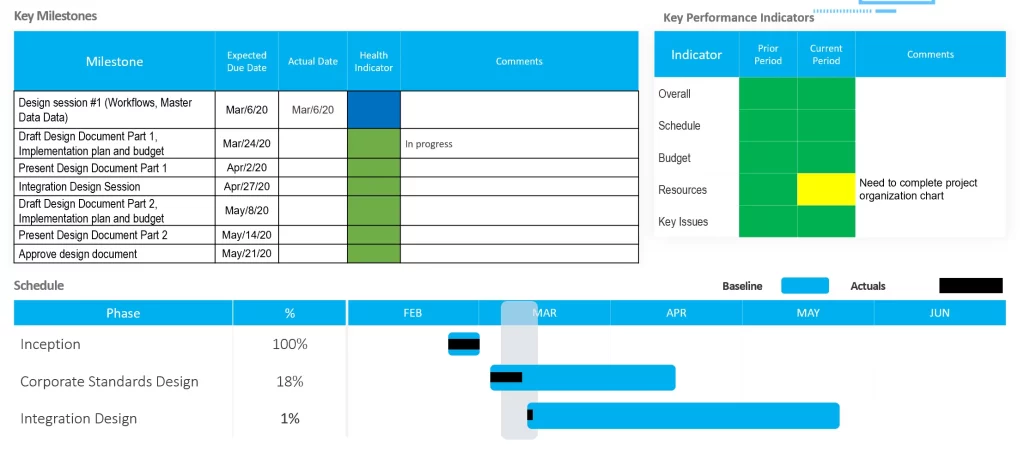
What is a status report?
It is a 2-page report of the condition of project which includes milestones, overall progress, indicators, completed tasks and tasks for the next week. Here’s a sample
How is the data transferred from my current system to EAM?
We provide you standard templates, in MS Excel format. You would extract this data from your current system and we have tools to import the data into Octave Attune EAM
How do you load the master data into Octave Attune EAM?
Octave Attune EAM has a data import utility tool.
Do we have to validate the data that is loaded into EAM?
Yes! You’re the experts when it comes to your data, but most importantly this can be an opportunity to clean and update the data. You may have obsolete assets and parts which you don’t want in the new Octave Attune EAM.
What happens when is time to begin using the system for real (production)?
Let’s start by defining readiness first. The production system has been configured, all the users have received training and are proficient in the new tools, the cutover has been completed. So now comes day 1 and people just go about their business with the new tools implemented in Octave Attune EAM. We are typically on-site to support the users.
Do you do a parallel? What is a parallel?
A parallel is/was a methodology where the old system and the new system would co-exist and users would transact in the old system and then re-create the transaction in the new system. After a pre-defined period, both systems were compared, and they should have the same data and the numbers would match. VisualK DOES NOT do parallels. Because, users (“in their daily rush”) would enter the transaction in their old, familiar system and put the transaction away in a pile for whenever they get the time to enter it into the new system. This is a recipe for disaster.
What happens if the system does not work as intended?
You would never find this in production. It is the responsibility of the key-users, during the User Acceptance Test to guarantee that Octave Attune EAM is READY for primetime.
How do we go back?
There is no going back. We have checkpoints along the way: Proposal, Design Document, User Acceptance Tests, Cutover, Audit and Closing.
What is a go-live?
This IS the day when Octave Attune EAM is used for the first time to transact and support the business.
How do you close a project?
Who decides that the project is over? A few weeks after the go-live we conduct an audit of the system to determine how the system is being used and if there any functional gaps. With this information we produce a closing report which is discussed to the customer. The customer will approve this report and that officially concludes the project. It is a joint decision between the two parties.