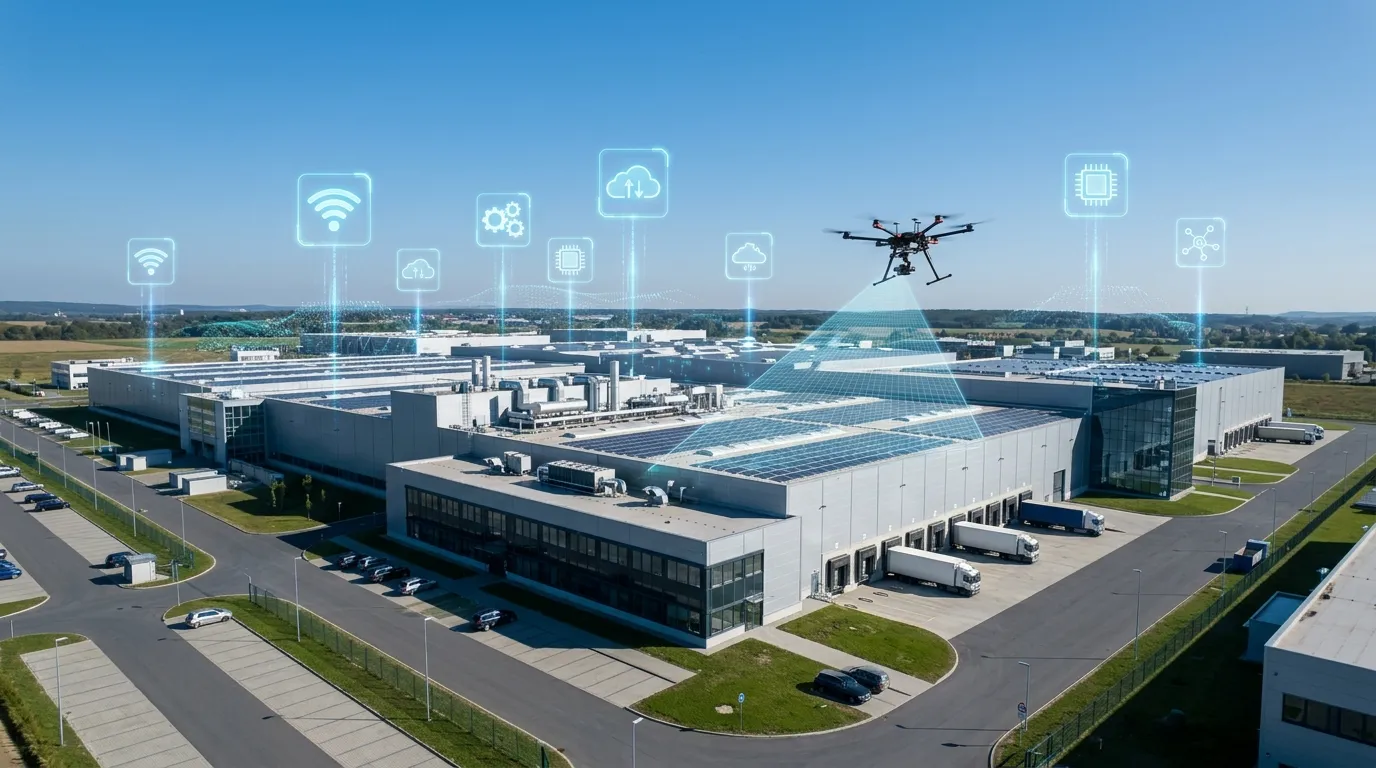
Three technologies—Internet of Things (IoT), artificial intelligence (AI), and drones—offer different ways to connect asset information with maintenance decisions.
Enterprise asset management software has evolved beyond tools for organizing maintenance tasks. It helps organizations track assets—from HVAC systems and manufacturing equipment to railway infrastructure—record their condition, plan preventive maintenance, and manage work orders.
For organizations evaluating Octave Attune EAM, formerly HxGN EAM and previously Infor EAM, these technologies raise an important question: how can information collected from assets become useful information for the people responsible for maintaining them?
This article revisits examples and ideas originally discussed in 2017, updating their framing without treating historical projects or announcements as current product commitments.
Ultimately, the future of EAM is about information exchange between equipment, systems, and people. More information can come from more sources, but its value depends on how effectively it supports action.
Internet of Things
The Internet of Things connects devices and equipment with systems that collect and use their data. GPS trackers, digital cameras, and sensors illustrate the different ways organizations can gather information about asset location, condition, and operation.
The original article highlighted CERN as an example of the relationship between connected equipment and enterprise asset management. At the time, CERN used Infor EAM to manage assets associated with its particle accelerator equipment and site infrastructure.
The important distinction was not simply having information about assets. It was also collecting information from those assets.
This combination of asset records, maintenance history, and operating data illustrates the intersection of industrial IoT and EAM. Information captured from equipment can provide context for evaluating its condition and determining what requires attention.
Connecting Infrastructure in Smart Cities
Beyond scientific research, the original article explored how IoT and EAM could support the management of urban infrastructure, including bridges, streets, water systems, and electrical assets.
One example involved San Francisco’s street lighting. The project described connecting lighting information with the city’s EAM system, including location data and repair information.
The objective was practical: give maintenance teams enough information to prepare the intervention before arriving at the site, rather than making separate visits to inspect, document, and repair the same problem.
As a historical example, it illustrates a broader principle: connected infrastructure becomes more useful when the information collected can support a maintenance response.
Artificial Intelligence
Connected assets can generate large volumes of data. Before that information becomes useful, it needs to be organized, interpreted, and presented in a way people can act on.
The original article identified artificial intelligence as a way to make that information easier to access and use.
One example was communicating with an EAM system through natural language. Instead of building a report manually, a user might ask:
“How many open work orders do we have on track 17?”
The objective is not simply to introduce another interface. It is to help users find relevant information more easily so they can spend more time evaluating priorities and making decisions.
Whether a particular system can answer that question depends on the capabilities available, its configuration, access permissions, and the quality of the underlying data.
The central idea remains usability: technology should make asset information easier to understand and apply, not add unnecessary complexity.
Drones
Drones offer another way to gather information about assets, particularly where access is difficult.
The original article described potential applications involving refineries, offshore platforms, railway infrastructure, bridges, aircraft, and cargo ships.
The basic concept is straightforward: a drone collects images or other inspection information from a useful vantage point, and that information supports the assessment of an asset.
Where an appropriate workflow or integration exists, findings can be associated with asset records and used to initiate or support maintenance work.
Choosing an Inspection Approach
The original discussion emphasized tethered drones, which connect to equipment on the ground through cables for power or communications.
That approach may be suitable for some inspection tasks. Other situations may require a different type of drone or a different inspection method altogether.
Selection should account for access requirements, operating conditions, applicable restrictions, and the information the inspection needs to capture.
Drones should not be presented as eliminating every access limitation or the need for shutdowns. Their role is to provide another inspection option where its use is appropriate and authorized.
The original article also discussed an Infor partnership related to drone-based asset management. That announcement belongs to the historical context of the article and should not be interpreted as confirmation of a currently available Octave Attune EAM offering.
It’s All About Connecting Data
What IoT, AI, and drones have in common is data.
IoT provides ways to collect information from connected equipment. AI offers ways to interpret and access information. Drones provide additional ways to capture inspection evidence.
The value comes from connecting that information with asset management processes.
A reading, image, or analytical result is most useful when it helps someone understand what is happening, decide whether action is needed, and organize the response.
Mobile access, analytics, cloud services, and system integrations can support that connection. However, the workflow needs to be defined: what information is collected, how it is reviewed, and what happens next.
For organizations exploring Octave Attune EAM, the starting point should be a practical business need—not technology alone.
Which assets need better visibility? What information is missing? How should a finding become a maintenance task? Which capabilities and integrations are included in the proposed solution?
The purpose is to help people work more effectively, with better information and a clearer connection between asset condition and maintenance action.
Contact Visual K to discuss how Octave Attune EAM and the appropriate integrations could support your asset management requirements.
Reference: http://diginomica.com/2017/05/25/iot-ai-and-drones-in-the-future-of-enterprise-asset-management/